June 25th, 2025
“In any moment of decision, the best thing you can do is the right thing, the next best thing is the wrong thing, and the worst thing you can do is nothing.” — Theodore Roosevelt
I’ve seen my share of teams stuck in the doldrums, including a zombie project that had been through so many requirements gathering sessions, design sprints and study phases that it took 18 months to get to the point of starting to write code. The chances of the business need being the same by the time the product is delivered are next to zero.
No team wants to be in that state, but many aren’t sure how to break out of it.
Team members often voice their frustration with things not changing… “I wish we could talk to the business team.” “I wish we could skip this useless meeting.” “I wish we got peer reviews earlier.”
When I ask why they don’t make the change, though, the answers are often vague and are usually some form of “they won’t let us”. Who is “they”, I ask; “If you can’t decide to do that differently, who can?” – and the room falls silent.
Slow decision-making or lack of clarity on who can make decisions is a killer for team morale and productivity. When people aren’t sure what decisions they, personally, are allowed to make or who ought to be making decisions, work will stall. When most decisions need to be made three steps up in the org chart, work will stall.
So what can be done about it? I’m a big believer in moving the authority to where the information is. If you’ve never seen David Marquet’s Greatness, take 10 minutes right now and watch this video. The aspiration of “don’t give instructions, give intent” is incredibly powerful.
There is no organizational switch to flip to make that happen, though. A practical starting point is to assess what the current decision-making structure looks like. I recommend a “delegation board”(1) in which common types of decisions are listed, and for each example you determine what degree of autonomy the team has in making that decision – ranging from fully delegated (the team has complete autonomy) to no autonomy – the team will be told what the decision is.
Start by creating clarity around the way things are now. This will set the stage for talking about how you’d like them to be.
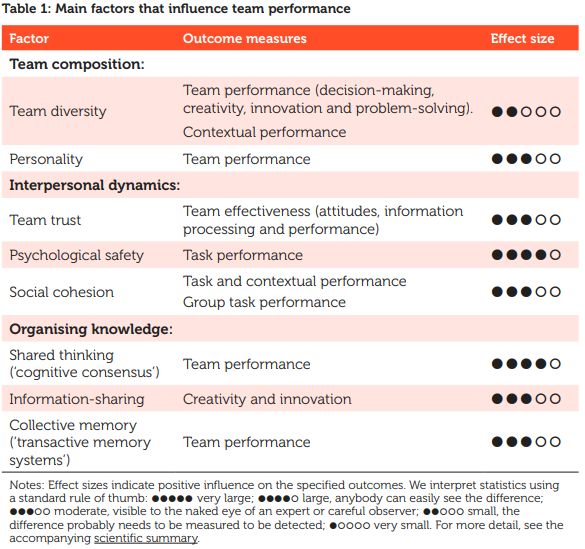
A 2023 study(2) by the Chartered Institute of Personnel and Development finds that cognitive consensus (“whether team members define and think about issues in a similar way”) is tied with psychological safety as the most impactful factors positively influencing team behavior. The delegation board is a good way to improve cognitive consensus while also serving as the foundation for improving team empowerment.
Where a team is empowered to make decisions but is reluctant to do so, consider introducing a risk framework. Often teams view the possibility of “wrong” decisions as unacceptable mistakes or failures when in fact they might represent learning opportunities. A risk framework can clarify when mistakes are to be avoided at all costs and when they can be used to improve.
Having an explicit conversation about what risks are unacceptable (and so require rigor in the decision-making process to avoid them) and where experimentation is encouraged can give the team more comfort with their empowerment. A risk framework can be developed by discussing examples of negative consequences and arranging them on a spectrum as demonstrated below.
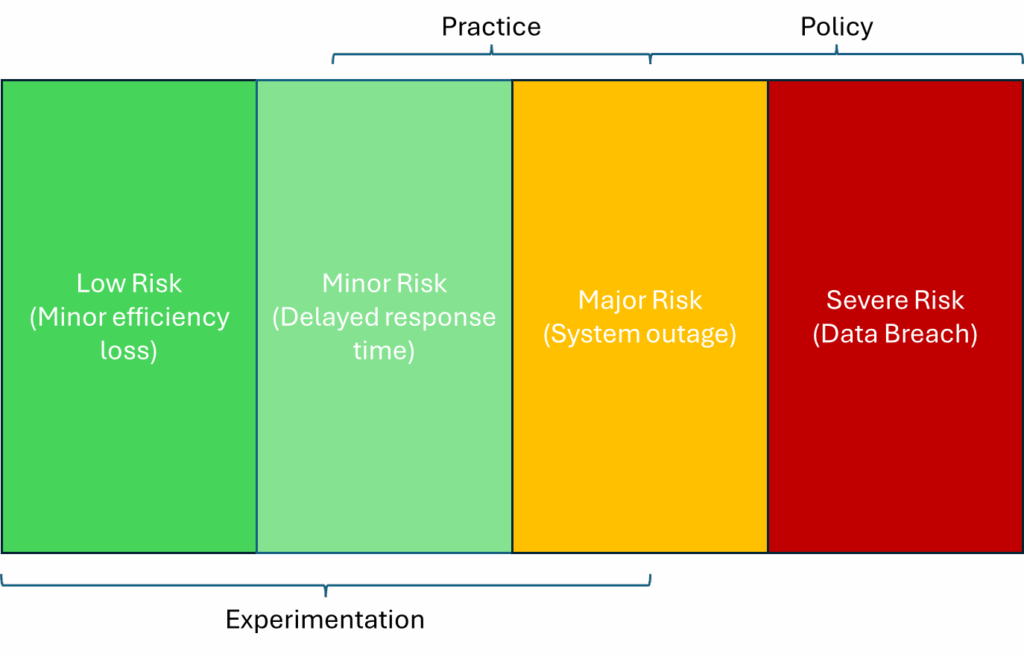
The severe risks should be guarded against with policies (what must we do) and lesser risks controlled with practices (what ought we do in most cases). Both policies and practices should be open to refinement, with more rigor needed around the former due to the severity of the risks they protect against. An excessive maze of policy and practice kills initiative and innovation, so be sure the reason for each is clear, and that the cost of having them is proportional to the risks they guard against.
Indecision drains energy, erodes confidence, and blocks progress. But with clarity around who decides what and how risk is managed your team can act faster and deliver more value.
Need help analyzing the decision-making structure for your team or organization? Please reach out at al@melecoaching.com
Tell Me More (Additional Reading)
- Managing for Happiness – Appelo
- Right Kind of Wrong – Edmondson
- Humanocracy – Hamel & Zanini
(1) – Jurgen Appelo, Managing for Happiness: Games, Tools, and Practices to Motivate Any Team (Wiley, 2016).
(2) – Young, J. and Gifford, J. (2023) High-performing teams: An evidence review. Practice summary and guidance. London: Chartered Institute of Personnel and Development