July 9th, 2025
“It doesn’t make sense to hire smart people and tell them what to do; we hire smart people so they can tell us what to do.” — Steve Jobs
One of the most common obstacles to team potential is when stakeholders, executives, or product owners prescribe solutions without first clarifying the problem or objective.
This is especially prevalent in IT work, where development teams are frequently asked to build some feature or functionality but lack perspective on what that functionality is intended to accomplish. The latest CHAOS report (Standish Group, 2020) indicates that only 31% of IT projects end successfully, and I believe this to be a huge contributing factor.
I was frequently guilty of this myself. With years of experience on the business side of things and strong technical skills it is an easy trap to fall into. I would plot a course of action for the team that was focused on the tactical steps of what to do while never being explicit about the strategic purpose for doing it.
The problem with that is that you’ve lost the opportunity to refine, test, and improve this plan based on the knowledge and experience of the team doing the work. You risk building things that will not accomplish your goals and incur a significant opportunity cost.
This diagram from Move Fast and Fix Things is a powerful one. The context was around diversity of experience on teams, but it applies to this situation as well.
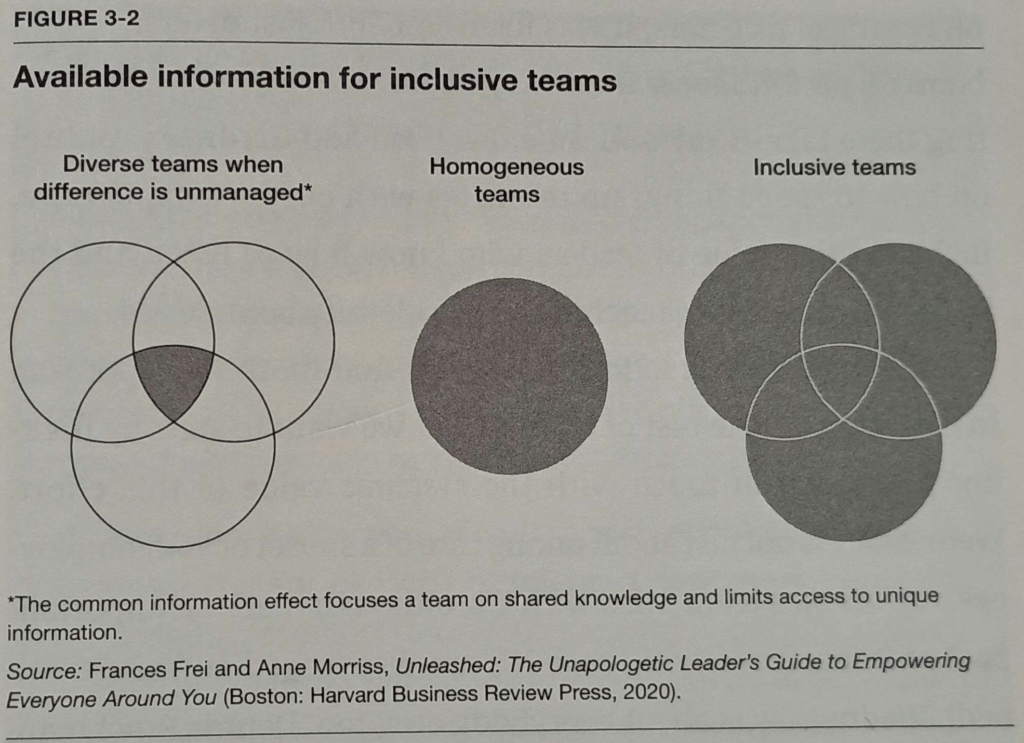
When you as a leader or product owner tell a team how to do something, you’ve limited their ability to contribute to just the intersection of their knowledge with your knowledge. When you tell them what your objectives are and leave the solution space open to their knowledge and creativity you invite the combined knowledge and skills of the collaborative team.
Consider this simple example.
Scenario A – Telling the Team How
A product owner tells the team: “We need to create a Google Form that customers can fill out after they make a purchase. Include fields for name, product, satisfaction score, and comments.”
The team does exactly that. It works, but it’s basic. The solution is constrained by the product owner’s experience with feedback tools—limiting the team’s role to executing instructions.
Scenario B – Telling the Team What
Instead, the product owner says: “Our goal is to understand what our customers think after a purchase so we can improve both the product and their experience.”
Now the team discusses options. A developer suggests an in-app rating widget for instant feedback. A designer proposes a gamified survey that improves response rates. A data analyst recommends sentiment analysis using natural language processing on open comments.
Together, they design a more effective, innovative, and engaging feedback system that goes far beyond a simple form.
In Scenario A, the team’s contribution was confined to the product owner’s idea. In Scenario B, the team’s diverse skills and creativity were unlocked, leading to a better outcome. By focusing on the what, the leader tapped into the full potential of the team—not just the overlap with their own ideas.
Over time, teams which are treated as task executors become stagnant and disengaged. The creative and motivated team members will leave, and those who remain will find their innovation and creativity muscles atrophied.
What concrete steps can you take to shift this mindset? I like this recommendation from War and Peace and IT: “The enterprise must stop thinking of its ideas as requirements to be given to IT. Instead it must treat its ideas as hypotheses about what will accomplish business goals.” (p. 173).
Three Steps to Shift from “How” to “What and Why”
- Be clear about the business goals you are trying to achieve.
- Involve the team that will do the work early in the process of problem analysis.
- Give objectives, not requirements.
Where you feel you know best about the “how”, and want to make sure the team has the benefit of that wisdom, use language that keeps open the possibility of alternatives, like “one possibility to accomplish <objective> could be <solution>”.
Need help ensuring that you’re getting the most business value from the work that you are doing? Please reach out at al@melecoaching.com.
Tell Me More (Additional Reading)
- Move Fast and Fix Things – Frei & Morriss
- War and Peace and IT – Schwartz
- Start with Why – Sinek