July 23rd, 2025
“The only thing of real importance that leaders do is to create and manage culture.” — Edgar Schein
Most people who have been in the corporate world for more than a little while have probably seen a wide spectrum of organizational cultures, from those that encouraged teamwork, collaboration and learning to those in which everyone kept their head down and tried not to be noticed.
In my experience, while the culture was hugely influential on a team’s ability to be successful, it was rarely consciously cultivated. Instead it was shaped by the observed behaviors of the leaders in the organization – regardless of whether those matched any purpose statement, motto or slogan that may have been handed out on that year’s company holiday gift. (Raise your hand if you have a mousepad or mug lying around with “respect”, “integrity” or “collaboration” written on it somewhere.)
Organizations that consciously shape a culture that complements their strategy create alignment between behaviors, decision-making, and strategic objectives. This alignment drives not only performance but adaptability and long-term success.
Culture can be a “soft” topic for some, difficult to discuss because of a lack of shared meaning, and used to vaguely explain a positive or negative morale in an organization. We’ll use Edgar Schein’s definition: “The shared values, beliefs, and assumptions that shape behavior within an organization.”
Consciously cultivating a culture is a necessary step to successfully execute any corporate strategy. Since strategy is also often used in vague ways, here’s what I mean by strategy, and where it fits with tactics:
- Objective: What are we trying to achieve? (Clear, specific goals)
- Desired Outcomes: What impact will success have? (Why this matters to the organization, customers, market position, etc.)
- Strategy: What guiding principles and key priorities will shape our choices and focus to achieve these objectives? (What we will prioritize, where we will focus, how we will differentiate?)
- Tactics: What specific actions will we take to execute the strategy and achieve success?
The Westrum typology of organization cultures identifies these broad categorizations of culture – pathological, bureaucratic and generative.1
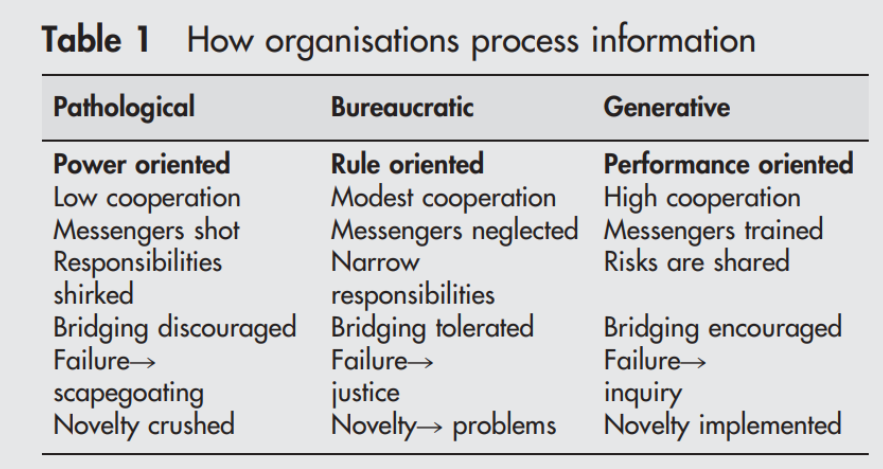
In their book “Accelerate” Dr. Nicole Forsgren, Jez Humble and Gene Kim demonstrate scientifically that performance-oriented organizational cultures are predictive of software delivery performance, organizational performance and job satisfaction. High-performing tech organizations with supportive cultures achieve better financial outcomes, higher customer satisfaction, and have greater adaptive ability.
How can culture enable strategy?
Every strategic and tactical decision made within the organization will be influenced by the organizational culture. If your organizational culture ridicules and punishes mistakes instead of using them as learning opportunities, mistakes will be hidden and innovation will stagnate. If your organizational culture rewards timely information flow and open communication the organization will make better decisions, faster.
A well-defined, intentional generative culture supports and enables strategy at every level because the shared values, assumptions and beliefs of the people doing the work are aligned with the principles and priorities that will help achieve the stated objectives.
In pathological cultures strategic principles and priorities are overridden by behaviors designed to build personal power silos, and in bureaucratic cultures they are overridden by behaviors designed to protect against personal risk.
Other advantages of a consciously cultivated culture include:
- A strong, distinctive culture is hard for competitors to replicate – creating a form of “soft” competitive moat.
- Cultural alignment attracts talent that fits, retains them longer, and improves engagement.
- Organizations with healthy cultures are better at navigating disruption, because trust, psychological safety, and shared purpose reduce friction in times of change.
- External stakeholders increasingly judge organizations by perceived internal culture (DEI, ethics, ESG).
- Culture shapes brand reputation, influencing partnerships, investor relations, and customer loyalty.
The Mechanisms at Work
Cultures that promote psychological safety (an environment in which people understand that their ideas, questions and concerns are welcomed and will be heard) lead to innovation and continuous learning.
Cultures that promote timely, effective and relevant information flow lead to organizations which can respond and adapt quickly to new information or other situational changes.
Cultures that clearly state and follow desired organizational values lead to efficient decision-making, resilience and reduced operational risk.
Cultures that are conducive to talent retention & attraction contribute reduced costs and improved productivity.
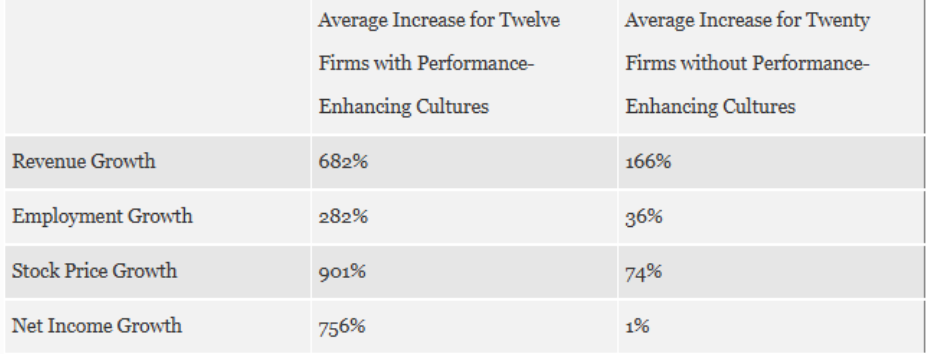
For those focused on the bottom line, here are some motivating numbers2:
Case Study
Let’s consider as a case study a software development team in the life insurance industry over the course of a 15 year period.
Initially this team produced 1 or 2 software releases a year. The culture could best be described as bureaucratic, with a weighty process for collecting and documenting specifications that focused on how to program and test features. There was no linkage between these features and their expected impact on the customer, or the corporate strategy. There was zero collaboration or discussion between the product’s end users and the team creating it. Team behaviors were primarily motivated by blame deflection or avoidance.
By the end of this period the team’s culture would best be described as “generative”. They were releasing software multiple times a week, regularly inspecting and adapting their work product and processes, and had effective and open lines of communication with the product’s users and end customers.
So what changed along the way to lead to these dramatically different results?
- Clarity of Purpose. Early in their time together they were provided with clarity as to why what they were doing was important to the business and important to the customer. Simplifying the application and underwriting process for life insurance products could make it easier for agents who primarily focused on Property and Casualty to sell life, which would not only generate more premiums – it would protect more families from the financial hardship of unplanned loss. Understanding that process simplification was a key differentiator allowed their solutions to be properly prioritized with that in mind.
- Test Automation. Investing heavily in test automation was another change that had a cultural impact. Not only did this investment demonstrate that quality was important, it also demonstrated that sustainable pace was important. Without test automation the regression effort of releasing software increases with each new capability. Understanding how to test each new feature became a discussion that was as important as what the feature itself was expected to do.
- Prioritization. Understanding that a “do it all, do it right, do it now” approach to prioritization was neither practical or effective and establishing a prioritization mindset that focused on return on investment and sustainable pace allowed the team to achieve long term success, rather than short term heroics that could never be maintained over the lifetime of the product.
- Process Adaptation. Right-sizing the process to the risks they were intended to control gave the team the freedom to test and learn while retaining the control structure that mitigated against financial risks. Clearly dividing policy (what must be done) from practice (what ought to be done in most situations) and empowering the team to use their expertise and judgement in the application of practices gave them the confidence and autonomy to make creative and innovative suggestions.
- Feedback Culture. While the desire for a feedback culture was present from the outset, the understanding of how to achieve it did not come until years into the team being together. Eventually, with an increased understanding of psychological safety and the insights of new team members who facilitated effective retrospectives they were able to move from this being an implicit desire to an explicit expectation with time and energy dedicated to collecting and acting upon feedback in pursuit of continuous improvement.
- Community. Finally, the team came to view each other as all part of a community of purpose. They knew they could count on one another, and they understood that when criticism was offered, it was offered in the service of making the product better. In most situations everyone in the community could assume the positive intent of every other person in the community, regardless of job function or position in the organizational hierarchy.
These changes were gradual and organic, and were never part of an explicit effort to change the culture. A deliberate focus on consciously cultivating culture could have led to this high-performing state much more quickly.
This case study is one I observed first hand. You can find more famously cited and broader reaching examples with Patagonia, Google, Microsoft, REI, Zappos and others.
Consciously Cultivating Culture
How can a team achieve something similar without taking 15 years to do it?
- Understand what you want the culture to be, and why you want it to be that way. This should clearly tie to your organizational objectives, and complement your strategy for achieving those objectives.
- Clearly communicate the desired culture. What are the shared values you want to guide decisions? What are the behaviors you want to see exhibited? Clearly describe how these behaviors are expected to help you successfully implement your strategy.
- Reinforce the desired culture with both words and actions from leaders and managers. If your desired culture is one in which quality is built in and teams are continuously improvising, ensure that there are investments in test automation and time taken to inspect and adapt. If you say that delivery should not come at the expense of the mental health of your teams, ensure that work moves at a sustainable pace. These examples are not picked arbitrarily – on software teams quality first, continuous improvement and sustainable pace are all predictive of high performing team and I would expect any desired culture to include them.
- Recognize and reinforce successes. Establishing or changing a team culture is not like throwing a switch. It will be a slow process with occasional jumps forward and occasional backsliding – even when recognized and reinforced. Without reinforcement it will revert to the previous norm. Even teams who have an established performance-oriented culture over long periods of time will revert to the characteristics of pathological or bureaucratic cultures if change disrupts the values, beliefs or assumptions that their generative culture was built on.
If you want to do something important as a leader, create a culture that contributes to your strategic success. Your culture will eat your strategy for breakfast – unless your strategy includes building the right culture.
Interested in creating a corporate culture that enables strategic success? Please reach out at al@melecoaching.com.
Tell Me More (Additional Reading)
- The Culture Code – Coyle
- Accelerate – Forsgren, Humble, Kim
- Leading Change – Kotter
- Hampden-Turner and C. Trompenaars, “A Typology of Organisational Cultures,”Journal of International Business Studies 13, no. 2 (1982): ii–22, as accessed via PubMed Central, https://pmc.ncbi.nlm.nih.gov/articles/PMC1765804/
- Kotter, J. (2011, February 10). Does corporate culture drive financial performance? (https://www.forbes.com/sites/johnkotter/2011/02/10/does-corporate-culture-drive-financial-performance/ ) Forbes. forbes.com